

Do Trees Need to Be Removed During Bamboo Removal?
If you are searching for bamboo removal near me or looking into professional bamboo removal in New Jersey, especially in Ocean County and surrounding areas, you may have heard different opinions about trees. Homeowners in towns across Ocean County, Monmouth County, and Middlesex County often receive conflicting advice when trees sit inside heavy bamboo growth. Some companies say trees must be removed to eliminate bamboo. Others say they can work around them.
So what is the truth?
In most cases, trees do not need to be removed during bamboo removal. A qualified contractor can remove bamboo while protecting healthy trees. However, there are certain situations, especially during bamboo barrier installation, where tree removal may become the safest option. The key is understanding the difference between removal and containment.
This article explains when trees can stay, when they might need to go, and how the work should be handled properly.
Bamboo Removal Around Trees
When performing full bamboo excavation and rhizome removal, experienced contractors work carefully around existing trees. Bamboo spreads through underground stems called rhizomes. These rhizomes travel through soil, wrap around roots, and often grow directly under tree canopies.
Removing bamboo does not mean ripping everything out aggressively. It means tracing the rhizomes, exposing them, and removing them without causing unnecessary damage to surrounding root systems.
What Is the Drip Line?
To understand why trees usually do not need to be removed, you need to understand the drip line.
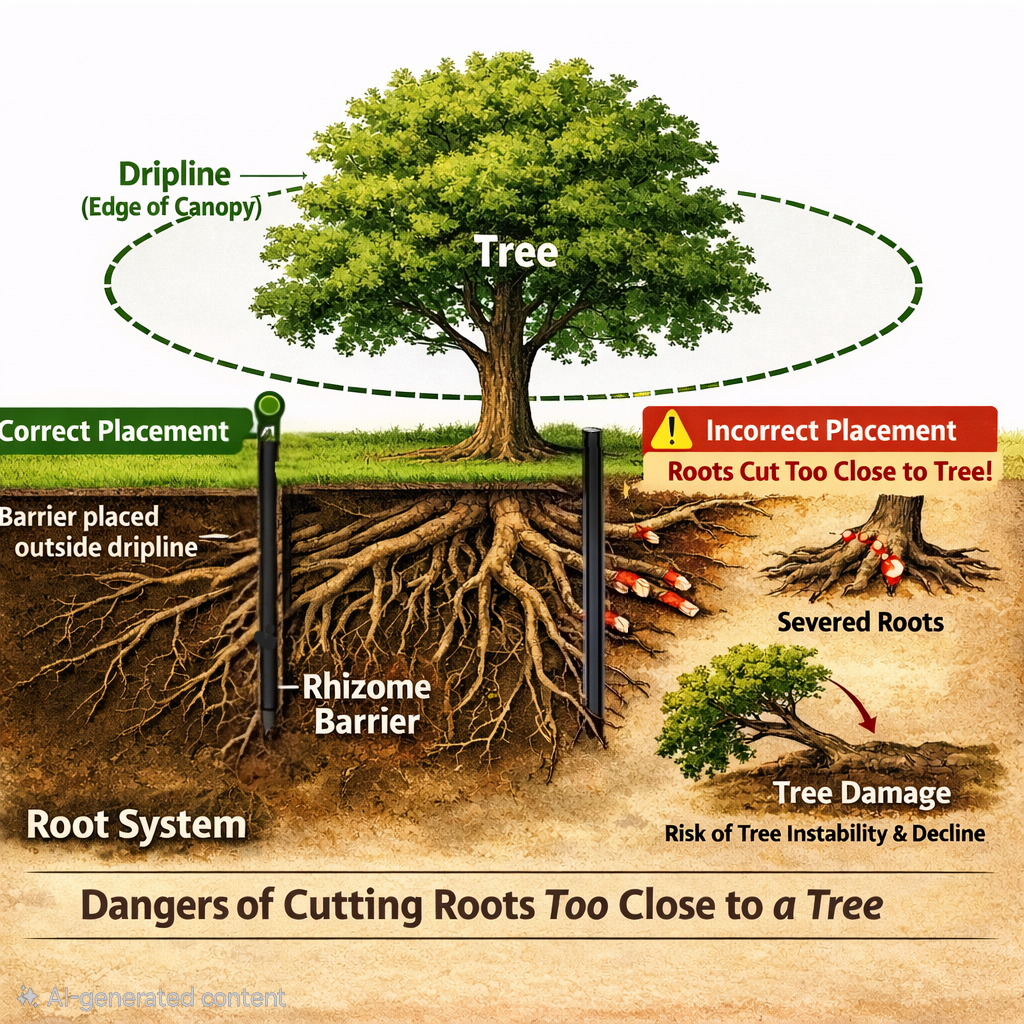
The drip line is the outer edge of a tree’s canopy. If you look up at the branches, imagine a circle on the ground directly below the furthest reach of those branches. That circle is the drip line.
Inside that area are many of the tree’s feeder roots. These roots absorb water and nutrients. Some structural roots that support the tree’s stability also extend through this zone.
Cutting too many roots inside the drip line can:
- Stress the tree
- Reduce nutrient and water uptake
- Increase risk of disease
- Affect long term stability
A professional bamboo removal company understands this and adjusts excavation methods accordingly.
How Bamboo Is Removed Near Trees
Proper bamboo removal around trees involves:
- Hand digging near the base of the tree
- Slower, controlled excavation inside the drip line
- Carefully exposing rhizomes before cutting them
- Avoiding major structural roots whenever possible
Heavy machinery can still be used on a bamboo removal project, but not recklessly. Skilled operators know when to step back and switch to hand tools. In sensitive areas near trees, the surface soil is often gently scraped back in thin layers to expose the rhizomes before cutting them. This light surface shaving removes only the top few inches of soil, allowing the crew to visually trace the bamboo without tearing through tree roots. By slowly peeling back soil instead of digging aggressively, rhizomes can be identified, separated from roots, and removed with much greater control.
In most residential bamboo removal projects in New Jersey, trees remain in place. The bamboo is removed. The tree stays healthy.
Why Some Companies Say Trees Must Be Removed
Homeowners are sometimes told that trees have to be removed in order to remove bamboo. That statement is usually not accurate.
In many cases, it comes down to experience.
A contractor who relies only on large equipment and fast digging may see trees as an obstacle. Working carefully around roots takes time, skill, and patience. It also takes an understanding of root systems and soil structure.
If a company does not want to perform detailed hand work, they may recommend tree removal because it simplifies the job.
Tree removal should never be suggested just to make excavation easier.
When Tree Removal May Be Necessary: Bamboo Barrier Installation
There is one situation where tree removal becomes more common. That is during bamboo barrier installation.
Bamboo containment barriers are installed to stop spreading bamboo from crossing property lines or entering protected areas. Installing a proper barrier requires trenching 24 to 36 inches deep and installing high density polyethylene barrier material vertically in the ground.
That trench often runs along fences, property lines, or narrow side yards. This is where conflicts with trees can occur.
The Risk of Trenching Through a Drip Line
Trenching through a tree’s drip line or directly against the trunk can create serious problems.
Cutting large structural roots during trenching can:
- Weaken the tree’s support system
- Increase the chance of the tree falling during storms
- Lead to decline over several years
- Create potential property damage or injury risk
In some cases, severing too many roots on one side of a tree can destabilize it immediately.
An inexperienced or careless company may say, “We can just cut the roots and trench through it.”
That approach focuses on finishing the barrier quickly, not on long term tree health or safety.
If you are being told that it is completely safe to trench straight through a drip line without consequences, that should raise concern. Every tree species responds differently to root loss. Soil type, age of the tree, and how many roots are cut all matter. Before agreeing to aggressive trenching inside a heavy root zone, it is wise to consult a certified arborist. An arborist can evaluate the tree’s structure and explain what percentage of root loss may compromise stability.
Do not simply go along with a contractor who downplays the risk. Once structural roots are severed, the damage cannot be undone. A quick trench today can lead to a leaning or failing tree years later.
The Hidden Cost of Tree Damage
When tree roots are cut carelessly, the damage is not always obvious right away. A tree may still look healthy for months or even years. But below the surface, its support system may be weakened.
In Ocean County and throughout New Jersey, strong coastal storms and saturated soil are common. A tree that has lost major structural roots is more likely to lean, split, or fall during high winds.
The hidden costs can be serious:
- A fallen tree can damage a roof, garage, fence, or vehicle
- Root loss can reduce property value if mature trees decline
- Emergency tree removal after a storm is far more expensive than proper planning during bamboo work
- Homeowners may face insurance claims, deductibles, and liability concerns if damage spreads to neighboring property
What may seem like a simple trench today can turn into thousands of dollars in repairs later.
That is why careful evaluation before trenching through a drip line is critical. Protecting the tree protects the home, the surrounding structures, and the long term stability of the property.
Evaluating the Safer Option
Before recommending tree removal during barrier work, several questions should be evaluated:
- Can the barrier path be adjusted slightly?
- Can the trench curve around the tree drip line while still remaining effective?
- Is there enough distance from the trunk to avoid major structural roots?
If the barrier line can be altered safely, that is usually the preferred solution.
However, if the only effective barrier path runs directly through a heavy root zone and rerouting is not possible, removal of that specific tree may be the most responsible decision.
In that case, tree removal is not about convenience. It is about preventing long term structural failure or safety hazards.
Bamboo Removal vs Bamboo Containment
Many misunderstandings happen because homeowners mix up bamboo removal and bamboo containment.
Bamboo Removal
- Full excavation of bamboo
- Tracing and extracting rhizomes
- Working carefully around existing trees
- No automatic need for tree removal
Bamboo Barrier Installation
- Deep trenching along a defined line
- Greater interaction with structural roots
- Higher risk when trees sit directly in the barrier path
- Occasional need for tree removal if no safe alternative exists
Every property is different. Soil conditions differ. Root systems differ. Bamboo density differs. That is why blanket statements about removing trees are misleading.
A Note on Perspective
This information is not meant to create fear or discourage homeowners from addressing serious bamboo problems. Invasive bamboo can damage foundations, driveways, neighboring property, and underground utilities if left untreated. Removal or containment is often necessary.
The intent here is to explain why quality care matters. Bamboo work affects soil structure, root systems, and sometimes large landscape trees. The goal is not to avoid the work. The goal is to perform it correctly, with caution, planning, and respect for the property.
When bamboo removal or barrier installation is handled with skill and proper evaluation, both the bamboo problem and the surrounding landscape can be managed responsibly.
Professional Care Matters: How Professional Bamboo Landscapers Protects Your Trees
At Professional Bamboo Landscapers, tree preservation is part of the evaluation process.
When we assess a property in New Jersey, we:
- Identify tree species and general root patterns
- Locate drip lines
- Determine where structural roots are likely concentrated
- Plan excavation accordingly
During bamboo removal, we use hand digging near tree bases and reduce machine pressure inside critical root zones.
During barrier installation, we design the trench path carefully. If a tree is directly in the barrier line, we explain the risks clearly and discuss options with the homeowner.
Tree removal is never recommended as a shortcut. It is only considered when safety, long term stability, or proper barrier function cannot be achieved any other way.
Final Answer
Do trees need to be removed during bamboo removal?
No, not in most cases.
Bamboo can be excavated and removed while preserving healthy trees when the work is performed correctly.
However, during bamboo barrier installation, if a tree sits directly in the trench path and the barrier cannot be safely rerouted, removal of that tree may be the safest long term solution.
The difference comes down to experience, planning, and whether the company values property safety over speed.
If you are dealing with invasive bamboo in New Jersey, including Ocean County and nearby communities, and want a clear, honest assessment, Professional Bamboo Landscapers can evaluate your property and explain your options in detail.
We take tree safety with the utmost seriousness. Trees are long term landscape assets. They provide shade, value, stability, and curb appeal. Damaging them carelessly during bamboo work is not acceptable.
Our approach is simple:
- Protect healthy trees whenever possible
- Use precision excavation instead of aggressive digging
- Respect drip lines and structural root zones
- Consult with arborists when root impact is a concern
- Recommend tree removal only when it is truly the safest option
Bamboo removal and bamboo barrier installation require planning, skill, and restraint. Anyone can dig a trench. Not everyone knows when to slow down.
If you want bamboo removed or contained without unnecessary damage to your property, Professional Bamboo Landscapers is here to help. We remove the bamboo. We protect your trees. And we design solutions built for long term stability, not quick fixes.
Our work throughout Ocean County and surrounding New Jersey communities has shown that careful excavation and proper barrier planning prevent unnecessary damage and reduce long term risk. Experience matters when root systems, property lines, and liability are involved.
Frequently Asked Questions About Trees and Bamboo Removal
Do I need to remove trees to remove bamboo in Ocean County, NJ?
In most residential bamboo removal projects in Ocean County and throughout New Jersey, trees do not need to be removed. Bamboo rhizomes can be excavated carefully around tree bases using controlled digging methods.
Is it safe to trench through a tree’s drip line for a bamboo barrier?
Trenching inside a drip line can damage structural roots and weaken a tree. In some cases, limited root cutting may be tolerated depending on the species and condition of the tree. However, aggressive trenching through major root zones can create long term safety risks. When in doubt, consulting a certified arborist is recommended.
Can cutting tree roots cause a tree to fall later?
Yes. Severing large structural roots, especially on one side of a tree, can reduce stability. The effects may not appear immediately. Trees sometimes decline slowly over several years after significant root loss.
What is the safest way to remove bamboo near mature trees?
The safest approach involves light surface scraping to expose rhizomes, hand digging near trunks, controlled excavation inside drip lines, and thoughtful planning before installing any containment barrier.
Who should I call for bamboo removal in Ocean County, NJ?
Homeowners in Ocean County, Monmouth County, and nearby areas should look for a company that specializes in bamboo removal and bamboo barrier installation, understands root systems, and evaluates tree safety before digging. Professional Bamboo Landscapers provides site specific assessments designed to protect both your property and your trees.
Our work throughout Ocean County and surrounding New Jersey communities has shown that careful excavation and proper barrier planning prevent unnecessary damage and reduce long term risk. Experience matters when root systems, property lines, and liability are involved.