

New Jersey’s New Invasive Species Law: What S1029 Means for Running Bamboo, Property Owners, and Landscapers
In January 2026, New Jersey officially changed the way it handles invasive plants. Governor Murphy signed the Invasive Species Management Act into law. The bill number most people will see tied to the final law is Senate Bill S1029 (P.L.2025, c.290).
If you own property in New Jersey, sell plants, work in landscaping, or are dealing with running bamboo, this law matters to you.
There has been confusion online about what this law actually does. Some believe bamboo is now illegal. Others think homeowners will be forced to remove plants from their yards. Neither of those statements is fully accurate.
This article breaks it down clearly:
- Where the law came from
- How S1029 connects to Assembly Bill A4137
- What the law actually regulates
- What it does not regulate
- How it affects homeowners, nurseries, and contractors
- What it means specifically for running bamboo
- How Professional Bamboo Landscapers LLC can help
The Background: Why New Jersey Passed This Law
For years, New Jersey did not have a unified invasive species law. Other states had formal systems for identifying, listing, and regulating invasive plants. New Jersey relied on a patchwork of agency authority and local ordinances.
As invasive plants continued to spread across the state, environmental groups, municipalities, and agricultural interests pushed for stronger action. Lawmakers responded with several proposals.
One of the major early efforts was Assembly Bill A4137, introduced in 2024. A4137 proposed:
- Creating a statewide invasive species framework
- Prohibiting sale and distribution of certain invasive plants
- Establishing an Invasive Species Council
- Granting enforcement authority to state agencies
While A4137 did not ultimately become law in its original form, its language and structure directly influenced Senate Bill S1029. The Assembly version and the Senate version were closely intertwined. When S1029 advanced and passed, it effectively carried forward the core ideas first outlined in A4137.
So yes, they are connected. A4137 laid groundwork. S1029 finalized it.
What S1029 Actually Does
The Invasive Species Management Act creates a formal, statewide system to regulate invasive plant species.
At a high level, the law does four major things:
1. Establishes a Statewide Invasive Species Framework
The law authorizes New Jersey agencies to create and maintain an official list of invasive plant species.
This replaces the prior informal or scattered approach with a unified regulatory structure.
2. Creates the New Jersey Invasive Species Council
The law establishes a permanent Invasive Species Council made up of representatives from:
- The Department of Environmental Protection
- The Department of Agriculture
- Environmental experts
- Agricultural interests
- Academic and conservation professionals
This council advises the state on which species should be regulated and how policies should evolve over time.
This is important because the list of invasive species is not frozen forever. It can change through rulemaking.
3. Regulates Commercial Activity
This is where most of the real impact happens.
Once a species is formally listed under the law, the state can regulate:
- Propagation
- Introduction
- Importation
- Sale
- Distribution
- Export
These restrictions are phased in over time. The law was designed to give nurseries, growers, and landscapers time to adjust inventory and operations.
4. Grants Enforcement Authority
State agencies now have clear authority to:
- Impose civil penalties
- Issue enforcement orders
- Seek injunctive relief
- Adopt rules and permit systems
This gives the law real teeth.
What the Law Does NOT Do
This is where misinformation spreads.
The law does not:
- Automatically criminalize homeowners for having invasive plants
- Force immediate removal of plants already established on private property
- Send inspectors to rip plants out of backyards
- Override every local property ordinance
S1029 focuses on regulating future sale, distribution, and propagation. It is forward-looking. It is not retroactive punishment for property owners.
If you currently have running bamboo growing on your property, you are not automatically violating this state law simply because it exists in your yard.
That said, local municipal ordinances are separate. Many towns already regulate bamboo under nuisance or containment rules.
Running Bamboo and New Jersey Law
Running bamboo has been a hot topic in New Jersey for years.
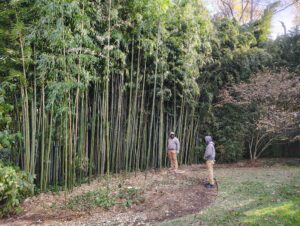
Certain types of bamboo, especially those in the genus Phyllostachys, spread aggressively through underground rhizomes. They do not stay where they are planted. They move laterally beneath soil, sometimes several feet per year.
This creates:
- Property line disputes
- Damage to fencing and driveways
- Lawn destruction
- Drainage complications
- Litigation between neighbors
Under the new invasive species framework, running bamboo can be subject to regulation once officially listed.
That means commercial activities tied to running bamboo may be restricted or require permits.
Again, this does not mean a homeowner is forced to remove existing bamboo. It does mean the state now has a legal structure to regulate how it is sold and handled in the future.
How This Law Affects Different Groups
Homeowners
If you already have bamboo:
- You are not automatically breaking state law.
- You are still responsible for preventing damage to neighboring properties.
- Local ordinances may still apply.
If you are thinking about planting running bamboo, you should reconsider. The regulatory environment is tightening, and future resale or compliance issues may arise.
Nurseries and Plant Sellers
If a plant species becomes listed under the Act:
- You may need permits to sell or distribute it.
- Certain sales may be prohibited altogether after the phase-in period.
- Violations can carry civil penalties.
Inventory planning now requires awareness of state rulemaking.
Landscapers and Contractors
Landscapers must stay informed about:
- What species are regulated
- Whether installation is allowed
- Whether removal is required under local codes
Planting running bamboo without understanding the evolving legal landscape could expose contractors to liability.
What This Means Long Term
The Invasive Species Management Act signals a clear direction:
New Jersey intends to reduce the spread of invasive plants through regulatory control.
For running bamboo, that likely means:
- Reduced commercial availability over time
- Increased public awareness
- Greater pressure on property owners to manage spread
- Stronger municipal enforcement
As awareness grows, more homeowners are choosing proactive removal to protect property value and avoid disputes.
Why Early Action Matters With Bamboo
Running bamboo spreads underground long before it is visible above ground.
By the time shoots appear across a property line, the rhizome network is already established.
The longer bamboo remains unmanaged:
- The deeper the root mass grows
- The wider the excavation zone becomes
- The more expensive removal becomes
Waiting rarely makes the problem smaller.
How Professional Bamboo Landscapers LLC Can Help
At Professional Bamboo Landscapers LLC, we specialize in one thing: bamboo removal and containment in New Jersey.
We are not general landscapers who mow grass and trim hedges to look pretty.
Running bamboo is not a cosmetic issue. It is an underground root system that spreads aggressively through soil.
Cutting the tops or mowing it down does not remove bamboo. It stimulates new growth.
Our approach is excavation-based. We target the rhizome network beneath the surface. That is where the real problem lives. If you do not remove or properly contain the root system, the bamboo will return.
Bamboo requires equipment, strategy, and an understanding of how it spreads underground. That is what we bring to every project.
Comprehensive Site Evaluation
We assess:
- Bamboo species
- Spread patterns
- Soil conditions
- Property boundaries
- Structural risks
Full Rhizome Excavation
Running bamboo spreads through underground rhizomes. Surface cutting does not solve the problem.
We remove the root network systematically.
Barrier Installation
When full removal is not practical, we install containment systems designed to limit future spread.
Regulatory Awareness
We stay current on New Jersey invasive species regulations and municipal bamboo ordinances so our clients understand their responsibilities.
Final Thoughts
New Jersey’s Invasive Species Management Act, enacted as S1029 and rooted in earlier efforts like A4137, represents a major shift in how the state approaches invasive plants.
It does not criminalize homeowners.
It does not mandate immediate removal.
But it does create a clear regulatory structure that will shape how running bamboo is handled in the future.
For property owners, the smartest move is proactive management.
If you are dealing with running bamboo in Ocean County, Monmouth County, Middlesex County, Union County, or surrounding areas, Professional Bamboo Landscapers LLC can provide a clear plan and a long-term solution.
Bamboo is not just a landscaping issue.
It is an excavation issue.
And it needs to be handled correctly the first time.